Test MCP servers
ToolHive's playground lets you test and validate MCP servers directly in the UI without requiring additional client setup. This streamlined testing environment helps you quickly evaluate functionality and behavior before deploying MCP servers to production environments.
Key capabilities
Instant testing of MCP servers
Configure your AI model providers, select your MCP servers and tools, and begin testing immediately in the desktop app. The playground eliminates the friction of setting up external AI clients just to validate that your MCP servers work correctly.
Detailed interaction logs
See tool details, parameters, and execution results directly in the UI, ensuring full visibility into tool performance and responses. Every interaction is logged, making it easy to understand exactly what your MCP servers are doing and how they respond to requests.
Integrated ToolHive management
The playground includes a built-in MCP server that lets you manage your other MCP servers directly through natural language commands. You can list servers, check their status, start or stop them, and perform other management tasks using conversational AI.
Threaded conversations
Keep multiple chats organized in a sidebar with starred and recent groups. Each thread remembers its own agent, model, and toolset, so switching threads doesn't reshuffle your selections. See Manage playground threads.
Agents
Switch between built-in and custom agents to change the system prompt and default toolset for a thread. See Choose an agent for a thread.
Message actions
Copy any message, edit and resend your own messages, or queue a new message while a response is still streaming. See Work with chat messages.
Attachments
Send images and PDFs alongside your prompt. See Attach files to a message.
Getting started
To start using the playground:
-
Access the playground: Click the Playground tab in the ToolHive UI navigation bar.
-
Configure provider settings: Click Provider Settings to set up access to AI model providers:
- OpenAI: Enter your OpenAI API key to use GPT models
- Anthropic: Add your Anthropic API key for Claude models
- Google: Configure Google AI API key for Gemini models
- xAI: Set up xAI API key for Grok models
- Ollama: Enter the server URL to connect to your local Ollama instance
(default:
http://localhost:11434) - LM Studio: Enter the server URL from the Developer section in LM
Studio where you started the local server (default:
http://localhost:1234) - OpenRouter: Add OpenRouter API key for access to multiple model providers
-
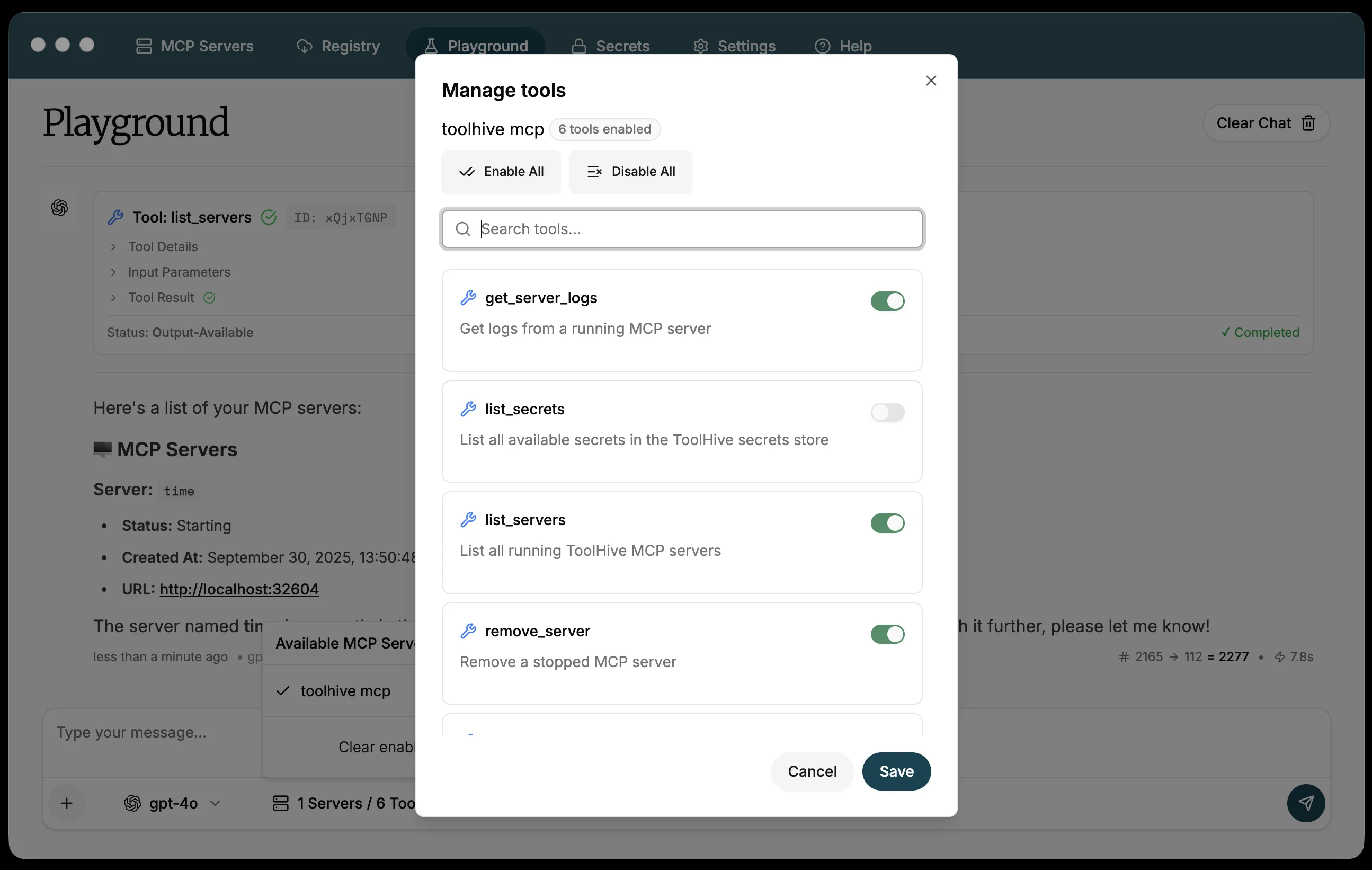
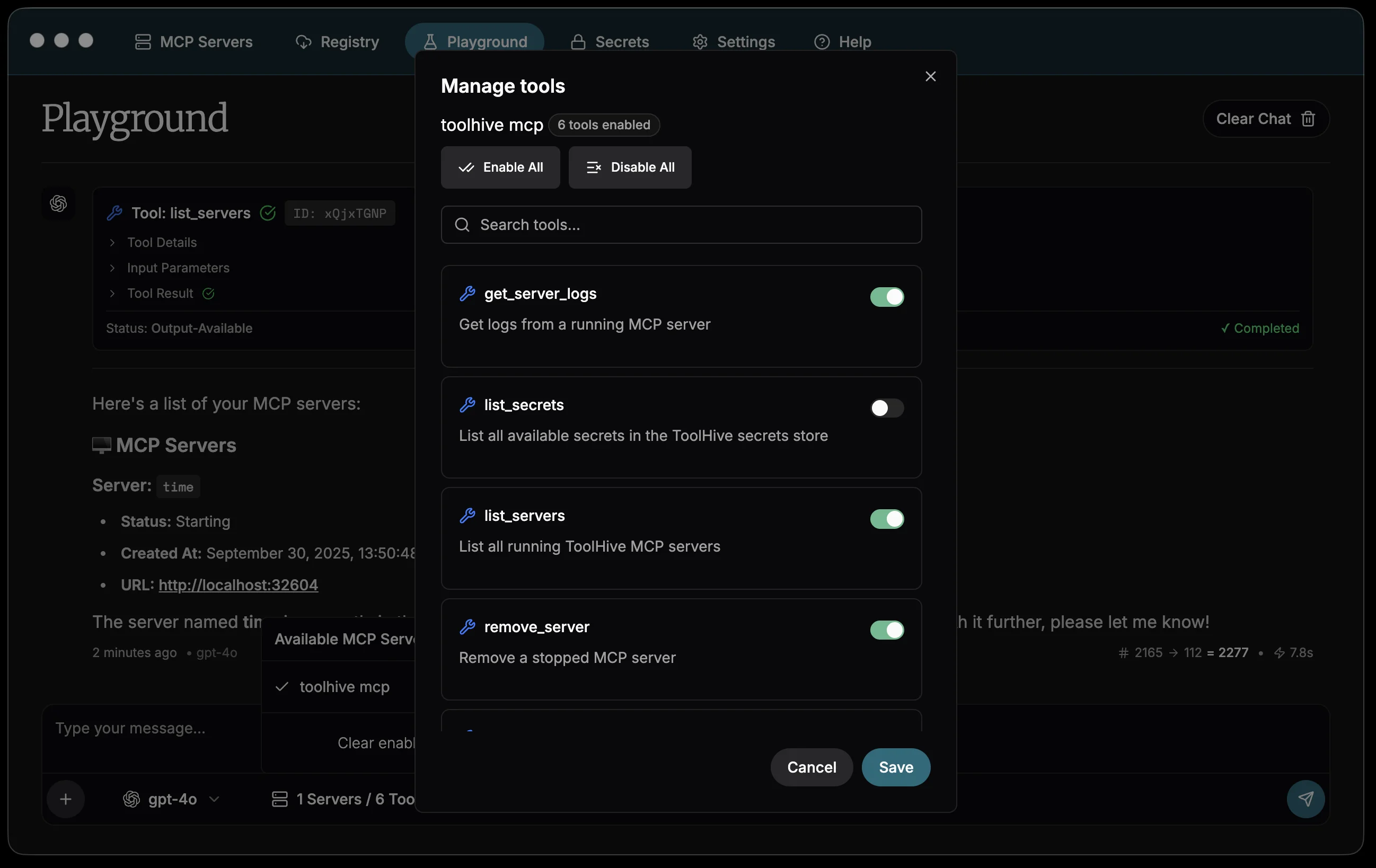
Select MCP tools: Click the tools icon in the chat toolbar to manage which MCP servers and tools are available in the active thread.
- View all your running MCP servers
- Enable or disable specific tools from each server
- Search and filter tools by name or functionality
- The
toolhive mcpserver is included by default, providing management capabilities
Tool selection is scoped to the thread. Other threads keep their own selections, and new threads inherit your most recent choices.
 tip
tipFor more control over tool availability, use Customize tools to permanently configure which tools are enabled for each registry server across all clients and threads. Playground tool selection only applies inside the playground.
-
Start testing: Begin chatting with your chosen AI model. The model will have access to all enabled MCP tools and can execute them based on your requests.
-
Manage chat threads: See Manage playground threads for sidebar, rename, star, and delete actions.
-
Attach images or PDFs: See Attach files to a message for supported types and limits.
Using the playground
Testing MCP server functionality
Use the playground to validate that your MCP servers work as expected:
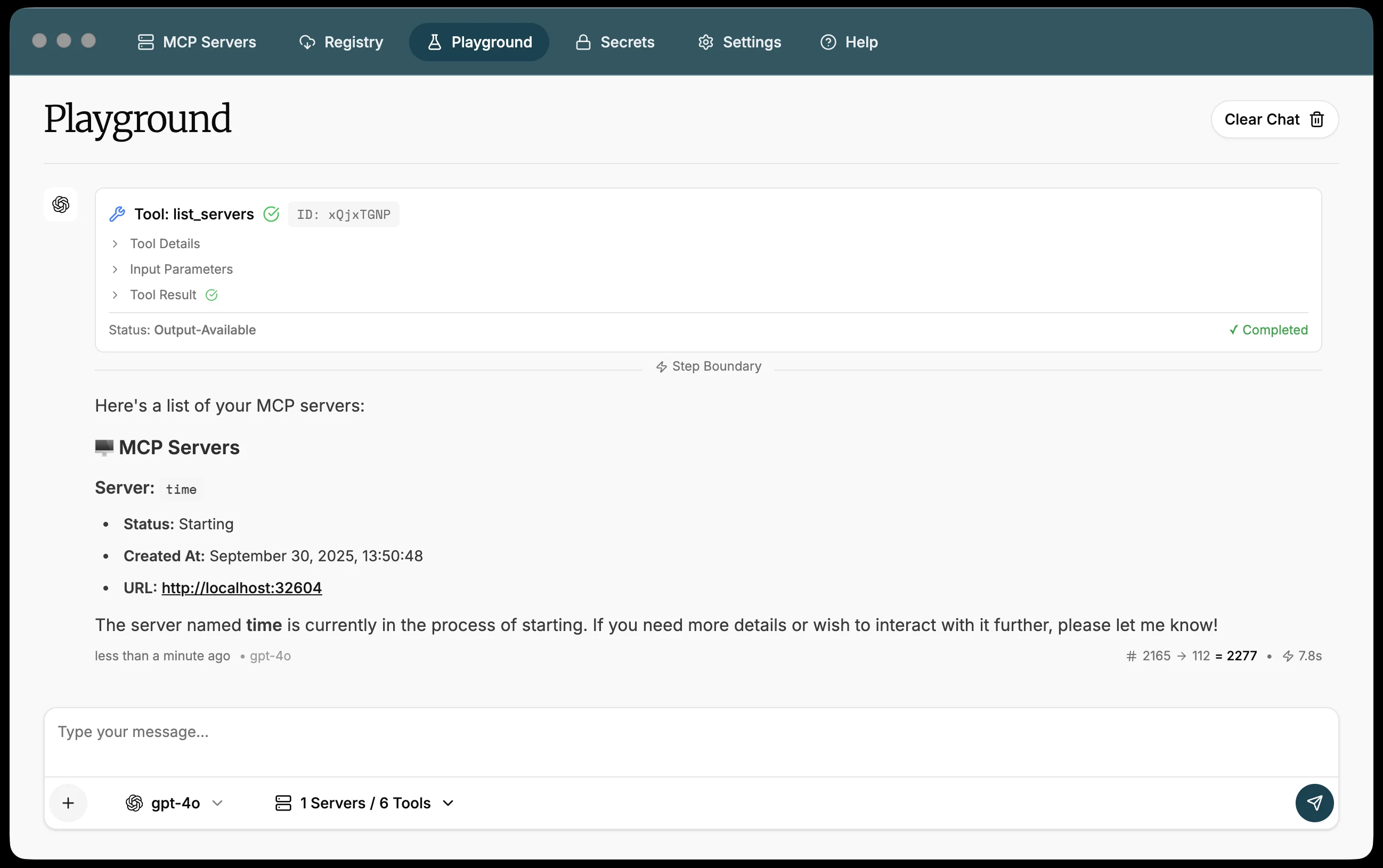
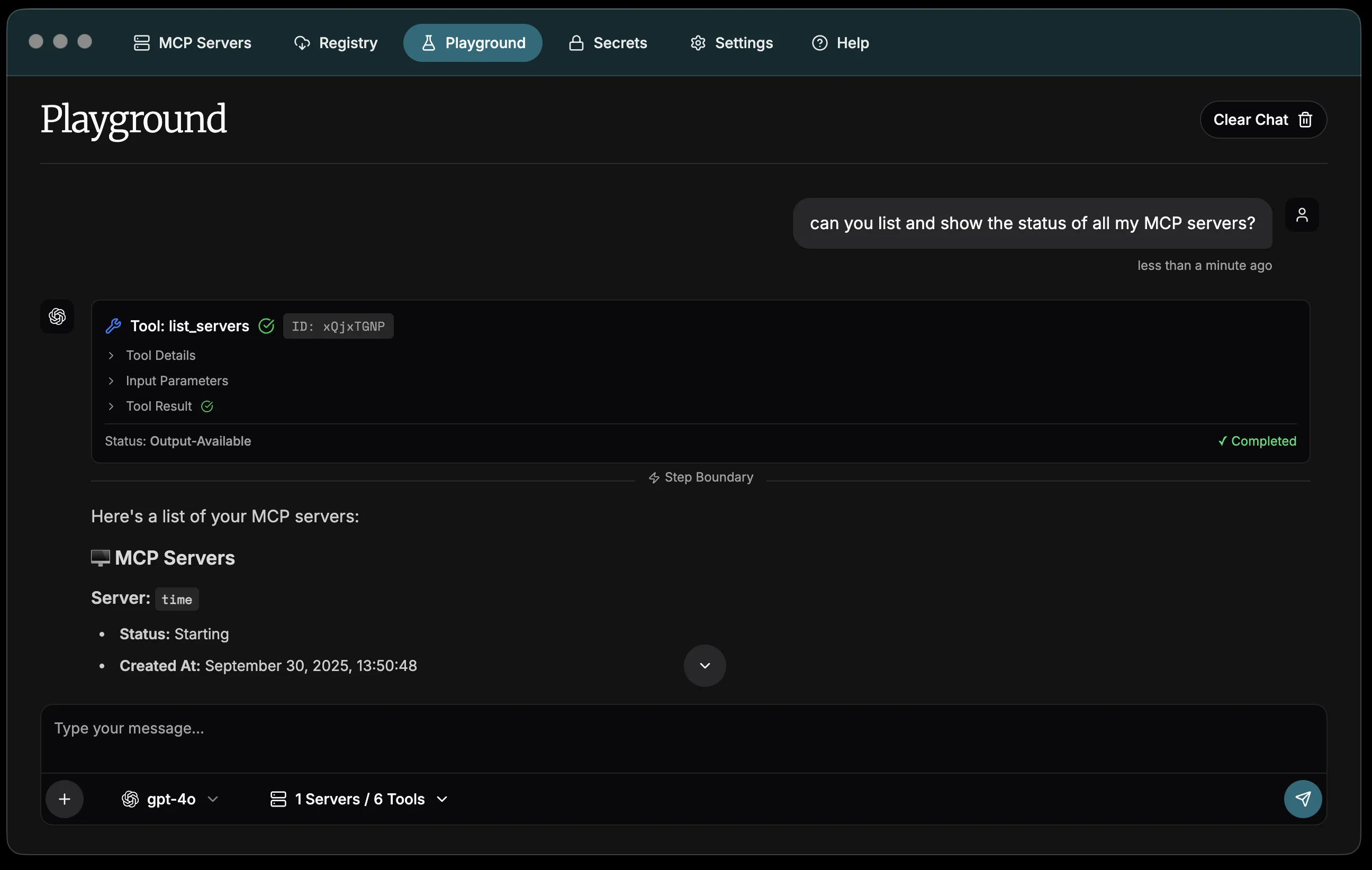
Can you list all my MCP servers and show their current status?
The AI will use the list_servers tool from the ToolHive MCP server to provide
a comprehensive overview of your server status.
Or test that an individual MCP tool is working as expected:
Use the GitHub MCP server to search for recent issues in the microsoft/vscode repository
If you have the GitHub MCP server running, the AI will execute the appropriate GitHub API calls and return formatted results.
Managing servers through conversation
The ToolHive desktop app automatically starts a dedicated MCP server
(toolhive mcp) that orchestrates ToolHive operations through natural language
commands. This approach provides several key benefits:
- Unified interface: Manage your MCP infrastructure using the same conversational AI interface you use for testing.
- Contextual operations: The AI understands your current server state and can make intelligent decisions about which servers to start, stop, or troubleshoot.
- Reduced complexity: No need to switch between the chat interface and traditional UI controls. Everything can be done through conversation.
- Audit trail: All management operations are logged in the same transparent way as tool executions, providing clear visibility into what actions were taken.
Take advantage of these integrated ToolHive management tools:
Start the fetch MCP server for me
Stop all unhealthy MCP servers
Show me the logs for the fetch MCP server
Validating tool responses
The playground shows detailed information about each tool execution:
- Tool name and description: What tool was called and its purpose
- Input parameters: The exact parameters passed to the tool
- Execution status: Whether the tool succeeded or failed
- Response data: The complete response from the tool
- Timing information: How long the tool took to execute
This visibility helps you understand exactly how your MCP servers are behaving and identify any issues with tool implementation or configuration.
Manage playground threads
The playground keeps each conversation in a separate thread so you can run
several testing sessions in parallel without losing context. Open the sidebar to
see your threads, with Starred entries pinned at the top and Recents
below. Untitled threads show as New chat until you give them a name.
Each row shows a relative timestamp such as just now, 5m ago, 2h ago, or
3d ago. Older threads show a short date instead.
To work with threads:
-
Start a new thread: Click New chat at the top of the sidebar.
-
Rename a thread: Double-click the thread row, or open its Thread options menu and choose Rename. You can also click the title or the pencil icon at the top of the chat to rename the active thread. The thread row's tooltip confirms the double-click action:
Double-click to rename
-
Star or unstar a thread: Click the star icon next to the thread title, or open Thread options and choose Star or Unstar. Starred threads appear under Starred at the top of the sidebar.
-
Delete a thread: Open Thread options and choose Delete to remove a thread you no longer need. The playground asks for confirmation:
Delete "
<THREAD_NAME>"? This cannot be undone.Confirm with Delete, or back out with Cancel.
Choose an agent for a thread
Each thread runs against an agent that sets the system prompt and a default toolset. Use the agent selector in the chat toolbar to pick one for the active thread. Two agents are built in:
- ToolHive Assistant is the default. It's tuned to manage your MCP servers, run tools, and answer questions about ToolHive itself.
- Skill Engineer is tuned to design, build, and audit skills.
To add your own, open the agent selector and choose Manage agents to open the Agents page, where you can create, edit, and delete custom agents with their own name, description, and system prompt. Custom agents appear in the selector alongside the built-ins.
Agent selection is per-thread, so different threads can run different agents at the same time. New threads inherit the agent you used most recently.
Work with chat messages
Hover over any message in the chat to reveal message actions:
- Copy: copy the text of a user or assistant message to your clipboard. Tool inputs, tool outputs, and internal reasoning are excluded; tool result blocks have their own per-block Copy button.
- Edit: only available on your own messages. Pre-fills the composer with the message text so you can revise and resend it.
The behavior of Edit depends on whether the assistant is currently responding:
- Idle: the edited message is sent as a new message at the end of the thread. The original message stays in the history.
- Streaming the last user message: the composer shows a chip reading Editing last message - submit to rewind and retry, and the submit button switches to a refresh icon. Submitting cancels the in-flight response, drops the partial assistant reply and the original user message, and sends your edited text as a fresh turn.
To exit edit mode, click cancel on the chip or empty the composer.
Queue a message while a response is streaming
If you type into the composer while the assistant is still streaming, the submit button switches to a send icon. Clicking it queues your message instead of stopping the response. The composer clears and shows a chip:
Queued:
<PREVIEW>- sends when the current response finishes
When the current response finishes, the queued message sends automatically. Click the X on the chip to cancel the queued message at any time. Only one message can be queued at a time; submitting a second one replaces the queued slot. Switching threads also clears the queue.
If the streaming response fails instead of finishing cleanly, the queued message stays in the chip but isn't sent automatically. Click the X to discard it.
See per-message cost
For assistant messages that use a paid provider (OpenAI, Anthropic, Google, xAI,
OpenRouter), the playground shows an estimated USD cost next to the token totals
(for example, 100 → 50 = 150 • $0.0012). Hover the totals to see a breakdown
of input, cached, output, and total cost.
Pricing comes from models.dev and is cached locally and refreshed daily. Local providers like Ollama and LM Studio, and any model without published pricing, render without a cost line.
These figures are estimates for guidance only. Refer to your provider's billing dashboard for authoritative usage and charges.
Attach files to a message
Add images and PDFs to a message so the model can read them while it works with your MCP tools. The composer accepts up to 5 files per message, each 10 MB or smaller, and supports image files and PDFs.
To attach files:
-
Open the composer toolbar menu and choose Add images or PDFs, or drag files onto the playground window. Drag-and-drop is enabled across the entire playground.
-
Type your prompt and send the message. If you send a message that only contains attachments, the playground records the message text as:
Sent with attachments
In the chat history, the playground previews each attachment alongside the message:
- Images appear inline. Click an image to open it in a larger modal preview.
- PDFs show as
📎 <FILE_NAME>with a Download link so you can save the original file.
If a file is rejected, the playground shows a toast that explains why:
-
When you exceed the per-message limit:
You reached the maximum number of files
You can only upload up to 5 files
-
When a file is over 10 MB:
File size too large
The file size must be less than 10MB
-
When a file isn't an image or a PDF:
File type not supported
Only images and PDFs are supported
The composer placeholder reflects the playground state:
-
Before you select a model:
Select an AI model to get started
-
After you select a model:
Type your message...
Recommended practices
Provider security
- Use dedicated API keys for testing that have appropriate rate limits
- Regularly rotate API keys used in development environments
- Consider using API keys with restricted permissions for testing purposes
- When using local providers like Ollama or LM Studio, ensure the server URLs are only accessible on your local network to prevent unauthorized access
Server management
- Start only the MCP servers you need for testing to improve performance
- Use the playground to validate new server configurations before connecting them to production AI clients
- Test different combinations of tools to understand how they work together
Testing workflow
- Isolated testing: Test individual MCP servers one at a time to validate their functionality
- Integration testing: Enable multiple servers to test how they work together
- Performance validation: Monitor tool execution times and responses under different loads
- Error handling: Intentionally trigger error conditions to validate proper error handling
Thread and attachment hygiene
- Delete unused threads so the sidebar stays focused on the work you actually return to.
- Star the conversations you want to keep close at hand. Otherwise they get pushed down as new chats arrive in Recents.
- Attachments are sent to your AI provider. Strip credentials, customer information, and other sensitive content from PDFs and screenshots before sharing them.
Next steps
- Learn about client configuration to connect ToolHive to external AI applications
- Set up secrets management for secure handling of API keys and tokens
- Explore network isolation for enhanced security when testing untrusted MCP servers
- Browse the registry to discover new MCP servers to test in the playground
Related information
Troubleshooting
Provider not working
If a provider isn't working:
-
For API key-based providers (OpenAI, Anthropic, Google, xAI, OpenRouter):
- If you see a 401 or "invalid API key" error, double-check the key in the provider's API keys dashboard. The key may have been rotated, revoked, or scoped to the wrong project.
- If you see a 429 or quota error, check your billing and usage in the provider's dashboard.
- Confirm the key has access to the model you selected.
-
For local providers (Ollama, LM Studio):
- Verify the server is running and reachable at the configured URL, including
the port (for example,
http://localhost:11434). - For LM Studio, confirm you started the server from the Developer section.
- Check that no firewall or VPN is blocking localhost traffic.
- Verify the server is running and reachable at the configured URL, including
the port (for example,
MCP tools not appearing
If your MCP server tools aren't showing up:
- Verify the MCP server is running on the MCP Servers page.
- Click the tools icon in the playground and confirm the server's tools are enabled for this session.
- Restart the MCP server if it shows as unhealthy.
- Check the server logs for errors.
Tool execution failing
If tools fail to execute:
- Check the tool's parameter requirements in the audit log.
- Verify any required secrets or environment variables are configured for the server. See Secrets management.
- Ensure the MCP server has the permissions it needs (network access, file system access). See Network isolation.
- Review the server logs for detailed error information.